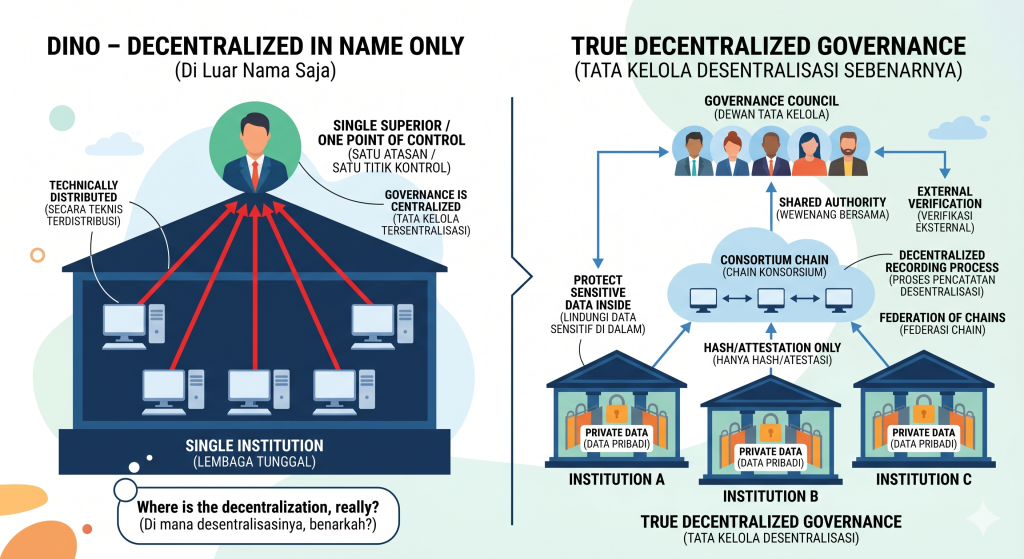
One problem I keep seeing is what I call DINO – Decentralized in Name Only.
On paper, a system claims to be “decentralized”, but in practice all meaningful power still sits in one place.
By design, decentralization is about how power is distributed: decisions, validation, and control should not concentrate at a single point. Blockchain gives us that capability. For many organizations, it makes perfect sense to use blockchain as an internal trust engine.
But if you install blockchain inside a single institution, under a single chain of command, you face a hard question:
Where is the decentralization, really?
If all power still flows to one superior, the system may be technically distributed, but governance is still centralized.
There are at least two ways to move beyond DINO:
- Build a real council.
Create a governance council with clearly defined, shared authority. Decentralization here is not about the number of nodes, but about how power is distributed and constrained in that council. The strength of the system depends on the strength of its governance. - Use a federated blockchain model.
Let each institution keep its own data and privacy, but rely on a federation of chains to finalize and attest to critical records. The consortium chain sits outside any single organization. It does not need access to all raw data; it only needs to verify that what is recorded follows shared rules and smart contracts that the federation recognizes.
In this way, you can:
- protect sensitive data inside the institution,
- while still ensuring that the recording process itself is decentralized and subject to external verification.
That is how we move from “decentralized in name only” to governance structures that are truly worthy of the word.
Leave a Reply